
Building, Breaking, Fixing
What I learned this month about stability, narrative, and why your website might be lying to you

Hi friends,
I’ve been deep in the build-learn-build loop again, and this past month taught me more than I expected. Forma PM grew in ways that feel quieter but more meaningful. Stability work, architecture fixes, value chains, a few security scares that I caught early, and a lot of clarity about how a product should behave.
Here’s what I’ve been working through.
1. Making Forma stable
I wanted Forma to feel calm. That meant tearing out old save logic, consolidating everything into one system, and rebuilding the foundation so people can work without thinking about the software underneath.
The app now saves offline, handles multiple tabs without confusion, and relies on a single autosave path instead of five scattered cousins. I also caught an issue with encryption keys during account switching and tightened the whole security layer. It felt like tedious work at first, but the payoff is a product that behaves consistently.
💡 Lesson: Audit. Then audit again. Then audit again after that!
2. Rebuilding Messaging Builder with value chains
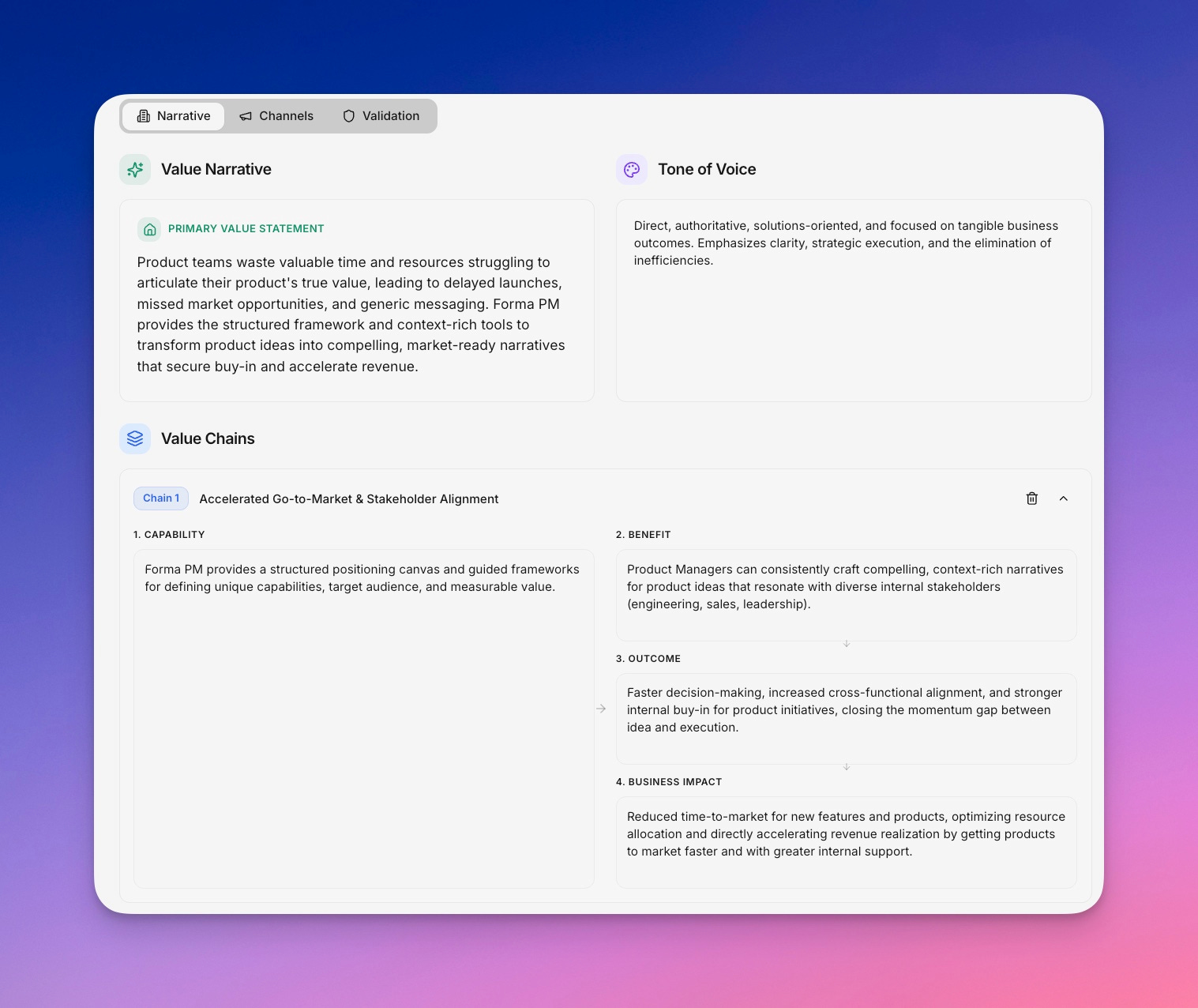
I built a new feature and then had to start over 🤦 The previous structure made things easy to fill out but didn’t push enough clarity. I rebuilt Messaging Builder around a value chain model that forces each step to connect. This means looking at Capability → benefit → outcome → business impact.
The tool now pulls upstream context from the other Forma modules and generates channel-specific content from a single narrative. I also added verdict-based validation so teams know when something is ready and when it needs more work. AI gathers evidence, rules determine the verdicts, and the whole thing behaves with more reliability.
💡Lesson: RAG is important when building. People expect to be helped, not to figure out where to go next.
In all its glory, the Messaging Builder now looks like this:
3. Lessons that stuck (and sucked)
This round of work taught me a lot about my own habits and the product’s expectations.
Fixing symptoms creates clutter, so I started digging until I understood the real cause every time. Security behaves better as a system rather than a list of tasks. Testing flows instead of pieces catches the problems that actually matter. Encryption punishes inconsistency, so I unified derivation methods across frontend and backend to avoid silent failures.
These lessons felt small while I was in them, but each one changed the way Forma works. They changed the way I build too. This month felt like leveling up without the fireworks, just steady progress and clearer thinking.
Website Teardowns
I’m kicking off a new series where I look at real websites and break down what’s working and what isn’t. Not to be harsh, not to dunk on anyone, but to understand how teams tell their story, where the narrative holds up, and where it quietly falls apart. It’s a way to learn from solid choices, spot the patterns that get in the way, and sharpen how we all think about product storytelling.
First candidate up: Intercom
Let me know if you want me to look at yours!
Until next time,
A
Great stuff. Mobile apps are exploding right now. Might be interesting to have some gaining traction run through the process.